Soluble humates, the potassium and sodium salts of humic acid, are often dissolved and injected through fertigation and drip systems. In hard water, part of the dissolved material can come out of solution as dark flocs or sludge that settles in tanks and collects on filters and emitters. This article explains why that happens, how water hardness is reported, and how to test a product in your own water before it goes into the system. It does not cover application rates or crop effects.
Why calcium and magnesium flocculate humates
Molecules of humic acid carry many carboxyl and phenolic groups. In alkaline solution, such as a dissolved potassium or sodium humate (our TDS give pH 9.0–10.0 at 1:100 for these grades), most carboxyl groups have lost their protons and carry a negative charge. The charge keeps the molecules apart and in solution. Monovalent counter-ions such as potassium and sodium do little to change this.
Divalent cations behave differently. Ca²⁺ and Mg²⁺ bind to carboxyl groups, neutralise part of the negative charge and can form bridges between binding sites on neighbouring humic acid molecules. As the charge falls and bridges form, the molecules aggregate into larger particles that no longer stay dispersed, and these settle as flocs. Cation binding by humic substances is described in detail by Tipping (2002) and Stevenson (1994).
The humic acid fraction is generally more sensitive to calcium than the fulvic fraction, which is smaller and carries more acidic groups per unit mass (Stevenson 1994). The tolerance of a given product still depends on its composition and on the water, so it has to be measured, not assumed.
Two other conditions cause similar problems. By definition, humic acid precipitates when its solution is strongly acidified (Tan 2014), so injecting a humate together with an acidic fertilizer, or into lines being cleaned with acid, can bring it out of solution. Iron and aluminium, and high concentrations of other salts in a stock tank, can also reduce solubility. For how humic acid is combined with fertilizers more generally, see Humic Acid in Fertilizers.
How water hardness is expressed
Total hardness is the sum of dissolved calcium and magnesium. Laboratories report it in several units, so check which one your water report uses before comparing it with any product figure:
- Milligrams of CaCO₃ per litre: the most common basis in water reports. Some reports give calcium and magnesium separately, as milligrams of Ca²⁺ and Mg²⁺ per litre.
- Millimoles of Ca²⁺ plus Mg²⁺ per litre: one millimole per litre corresponds to about 100 milligrams of CaCO₃ per litre.
- German degrees (°dH): one °dH is defined as 10 milligrams of CaO per litre.
- French degrees (°fH): one °fH is 10 milligrams of CaCO₃ per litre.
To convert separate calcium and magnesium results to the CaCO₃ basis, multiply milligrams of Ca²⁺ by 2.50 and milligrams of Mg²⁺ by 4.12, then add the two. These factors follow from the molar masses. A water report usually also gives pH, alkalinity (mainly bicarbonate) and electrical conductivity. These matter as well: alkalinity buffers the pH of the solution, and the total salt load adds to what is already in the stock tank.
What our TDS state about fertigation and hard water
Only some of our grades list fertigation as a use on their TDS. The insoluble humic acid powders and granules (HA grades) are for soil application and granulation, and the sodium humate TDS list soil application and fertilizer formulations, so neither is covered by this article. The grades that do list fertigation are:
- Potassium humate KH-01F, KH-01P, KH-02C, KH-02P and KH-04F: “Fertigation and liquid fertilizer production (dissolve before use)”. The water solubility of KH-01F and KH-01P is “to be confirmed” on their TDS. KH-05G and KH-06R are listed for soil application and granular blending only. Application methods are covered in How Potassium Humate Is Applied.
- Fulvic acid FA-02P: “Fertigation and drip irrigation formulations”. Its TDS gives a flocculation limit of 350 mg CaO per 1 L water (CaCl₂ solution).
- Potassium fulvate KF-01P, KF-02F and KF-02P, and bio fulvic acid BKF-01P: fertigation formulations are a listed use. For how fulvic products are used, see Using Fulvic Acid in Fertigation, Foliar and Water-Soluble Fertilizers.
For the KH, KF and BKF grades, a hard-water or flocculation figure is not stated on the TDS. Whichever humic acid salt or fulvate you use, test it in your own water before use.
The FA-02P figure was measured in a calcium chloride solution, so it describes calcium tolerance under test conditions. Your water also contains magnesium, bicarbonate and other ions, and the fertilizers in the tank add more. Because one German degree is 10 milligrams of CaO per litre, the figure corresponds to 35 °dH. Convert your water report to the same basis before comparing, and treat the comparison as a guide, not a guarantee.
Running a flocculation (jar) test
The procedure below is a general check, not a standard method. Use the same water, product batch and fertilizers that will go into the system.
- Collect water where it enters the mixing tank, after any treatment, in clean clear glass jars. Prepare a second set with distilled or deionised water as a reference.
- Dissolve the humate fully in a small amount of water first, then make it up to the concentration planned for the stock tank. Prepare another jar at the final dilution that reaches the emitters.
- Add the other fertilizers one at a time, in the order planned for the tank, stirring after each. Note any heat, gas, colour change or cloudiness.
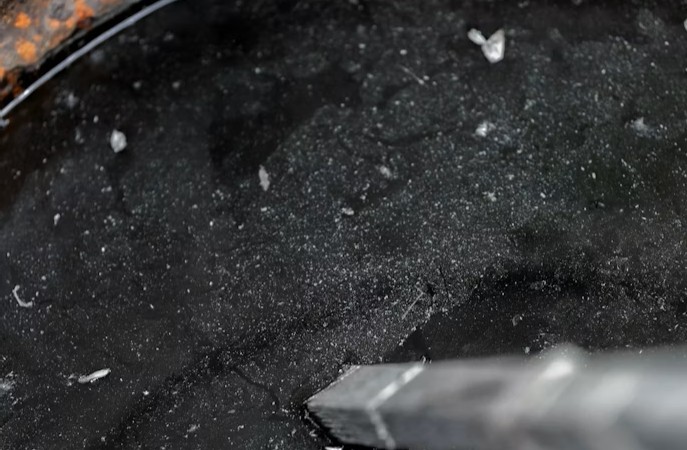
- Let the jars stand and look again after 30 minutes, after a few hours and the next morning. Look for flocs, sediment, a surface film, or a clear layer above a dark one. Dark flocs are humic acid that has come out of solution.
- Measure the pH of each jar. A large drop in pH after adding an acidic fertilizer is a warning sign even if no flocs have formed yet.
Interpret the result against the reference jars. If flocs form in your water but not in distilled water, hardness is the likely cause of humic acid coming out of solution. If they form in both, look at the fertilizer mix, the mixing order or the pH.
Filter and emitter check
A jar can look clear while fine particles still reach the filter. Before injecting a new product or mix into a drip system:
- Pour a measured volume of the final solution through a screen or disc of the same mesh as the system filter, and time it against the same volume of plain water. Inspect the screen for residue.
- Run the first injection on one block or line only. Record the pressure difference across the filter before and after injection, and check the flow at the last emitters on the line.
- Flush the lines with clean water after injection, so that no concentrated solution stands in laterals and emitters.
- Keep calcium fertilizers, and acids used for line cleaning, apart from the humate, in a separate tank or at a separate time.
If you see residue or a rise in pressure difference, go back to the jar test and change the water source, the mixing order or the grade before using the system again.
FAQ
Can I treat the water first?
Blending with a low-hardness source lowers calcium and magnesium. Ion-exchange softeners replace calcium and magnesium with sodium. Acidifying water to neutralise bicarbonate lowers the pH, which can precipitate humic acid. Any treatment changes the result, so repeat the jar test afterwards.
Does the FA-02P flocculation limit apply to potassium humate?
No. The figure is stated for FA-02P only. For potassium humate and potassium fulvate grades it is not stated on the TDS.
Can humic acid powder be used in drip irrigation?
No. Our humic acid grades are not water soluble; their TDS list soil application and use as a raw material for granulation and organic fertilizers.
Can you help with a specific water?
Yes. Send your water report and the planned fertilizer mix through our contact page, and we can suggest which grades to test. Application rates depend on crop, soil and formulation; ask us for technical guidance and run a small trial first.
References
- Stevenson, F.J. (1994). Humus Chemistry: Genesis, Composition, Reactions, 2nd ed. Wiley.
- Tan, K.H. (2014). Humic Matter in Soil and the Environment: Principles and Controversies, 2nd ed. CRC Press. doi:10.
1201/ b17037 - Tipping, E. (2002). Cation Binding by Humic Substances. Cambridge University Press. doi:10.
1017/ CBO9780511535598